
This is not a review of the classic Sean Cunningham horror film or its next installment. I have never seen it or any of its siblings. Add to that the rest of that genre: Halloween, Texas Chainsaw Massacre, etc., etc. I have no intention of ever watching any of them, even if there’s nothing else to watch. I’ll re-watch Downton Abbey or Inspector Morse or just about anything on PBS or Acorn again before I’ll deliberately sacrifice two hours of my time to a sickening celluloid display of human depravity.
We can see enough of that on the news, if masochistic enough to watch. I’m not.
No, this is just a reflection on this infamous date, brought into sharper focus by the acute awareness that it’s 2020 and, if the rest of the year is any indication (I don’t need remind anyone), literally anything can happen.
My great-grandfather was born on Friday the 13th, in October of 1882; it was enough to send him to bed on his birthday every year just for precautionary protection. Being Irish, he had a healthy respect for superstitions; being a Kentuckian, he had enough common sense to discern what was real and what likely wasn’t. He wasn’t afraid of black cats, but he knew not to walk under a ladder. And he knew to avoid Friday the 13th if he could. He lived to the ripe age of 88.
The number 13 itself has a history. “Normal” things seem to come in dozens: months of the year, signs of the Zodiac, disciples, and so forth. It’s abnormal, an abrogation of normalcy, to have that one extra, that fifth wheel, so to speak. People go out of their way to avoid it: elevators go directly from the 12th floor to the 14th, hostesses refuse to seat 13 at their tables (an allusion to the Last Supper and Judas’ betrayal of Jesus); even the Code of Hammurabi supposedly skips the 13th law. Sometimes a number isn’t just a number.
The fear of the number 13 is actually called triskaidekaphobia. You know it’s serious when there’s a name for the phobia surrounding something. I know, being subject to some named phobias that I take rather seriously.
Put that together with Friday, and you have created a monster, appropriately enough. Now, it may come as a surprise that Friday is the day of the week viewed most negatively in traditional annals. Today, most of us look forward to Friday, wishing the rest of the working week away so the weekend can begin, but historically, Friday has been denigrated almost to the level of 13. Again, a Christian reference probably explains it: Jesus was crucified on Friday. Friday the 13th? Better follow my great-grandfather’s example.
I am intrigued by a story from the 14th century regarding a possible origin for the fear of Friday the 13th. According to History.co.uk, Pope Innocent II established the Order of the Knights’ Templar in 1139 to provide military protection to Crusaders traveling to the Holy Land to fight against the infidel. Known as “God’s Bankers,” the Order also was given the responsibility of maintaining the treasury for the Crusades, which, along with amassing great wealth themselves from the spoils of the battles and the generous rewards of land from grateful rich Europeans, contributed to their unprecedented financial power.
Such prosperity cannot go unnoticed or unenvied by the Have-nots, and when the Have-nots have at least some modicum of power, it will not go unchecked. In 1307, King Phillip IV of France, in a jealous scheme to punish the Order and confiscate its wealth, issued a series of secret warrants across Europe, resulting in the mass arrest of hundreds of members of The Knights’ Templar all on one fateful Friday in October—Friday, the 13th. Bogus charges against these members led to the torture and death of hundreds, as well as the demise of the Order and its concentrated wealth and power. October 13, 1307, the date of the unexpected and sudden fall of the Mighty en masse, would live on in infamy. The original Friday the 13th.
Even if you’re not a Mason or a member of the illusive Illuminati (supposed descendants of that first Order), the memory of such massacre would give one pause.
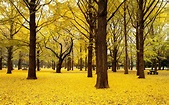
Oddly enough, every autumn I do pause to reflect on the surprise attack on the Knights’ Templar as I wait for the Gingko leaves to turn color. Unlike most deciduous trees in the fall, groves of Gingko maintain their green hue the longest time, “though worlds of wanwood, leafmeal lie” all around them, as Gerard Manley Hopkins might say. Then, as if receiving a stealthy midnight summons, they turn, en bloc, from lovely green to a uniform bright yellow, a gold that stays beautifully, albeit briefly, for a final flash of color not unlike the last fireworks of a patriotic evening’s display. But then, even more astonishingly, again as if impelled by sudden secret messenger, one morning we wake to witness all their gold upon the ground, a circular skirt discarded at their feet, a pool of Tiger butter.
Not this year. Not 2020. Reveling in the oranges and reds of Maples and Sweet Gums and all other deliriously decorous deciduous trees, I waited patiently for my Gingkos’ transformation. October passed into November. Other leaves colored, fell. For the Gingkos, though, the change never came. The leaves did not turn yellow, the trees did not discard their leaves en masse. Instead, this year, 2020, the leaves shriveled on their arthritic branches where they still cling, waiting for the first real frost, the icy grip of death.
Didn’t they get the memo this year? Maybe it wasn’t sent. Maybe it was delayed or lost or discarded with the uncounted ballots of this last uncertain election. Of course. It’s 2020. What should the trees be different? Obviously, nothing is sacred any more.
I think of the detective Jake (Jack Nicholson) as he hesitates to leave the devastating last scene of Roman Polanski’s 1974 masterpiece, Chinatown. His partner sums up everything in his final advice, “Forget it, Jake,” he says. “It’s Chinatown.”
Forget it. It’s 2020. And Friday the 13th to boot.
–Rebecca L. Briley
 brileyrebecca